The Coiron in two minutes
Between 8 and 6 million years ago, a series of eruptions poured very fluid basalt lava over this part of the Ardèche. It ran down the valleys of the time and buried the old bed of the Ardèche river, which then flowed this way towards the Rhône. Depending on where you stand, there are between two and ten lava flows stacked on top of one another.
Then erosion went to work. The soft limestone around it was worn away while the hard basalt stayed put: what had been a valley floor became a raised plateau. Geologists call it relief inversion. Today the Coiron stretches for about 20 kilometres south of Privas, at around 700 metres, rising to just over 1,000 metres near the Col de l’Escrinet.
What strikes you first are the edges of the plateau: long dark cliffs, sometimes split into neat columns. These are basalt columns, or orgues basaltiques, which form when lava cools slowly and cracks into prisms.
The black-stone villages
On the Coiron, people built with what the land gave them: basalt. The houses are dark and solid under pink tiled roofs, and the villages sit on the edge of the cliffs as if to keep an eye on the valley.
Mirabel, the sentinel
Eight minutes from the Mas, Mirabel stands on the southern rim of the plateau beneath its 12th-century tower. The name comes from the Latin mirabilis, “admirable”, and the view lives up to it: from the foot of the tower, at 550 metres, you take in a large part of the Ardèche, and on clear days Mont Ventoux and the peaks of the Vercors. You can see the tower from the suites; sooner or later, everyone wants to walk up to it.
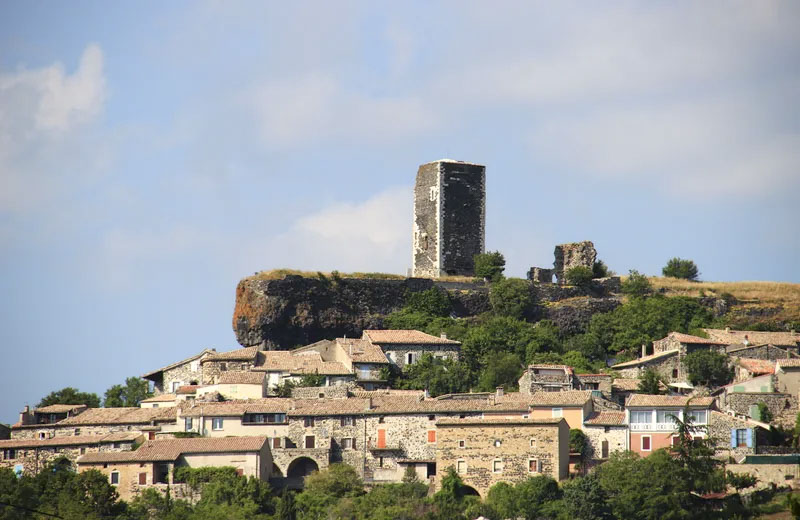
Saint-Laurent-sous-Coiron
Five minutes away, Saint-Laurent-sous-Coiron sits on a spur of lava ringed by black-stone walls. Narrow lanes, a square bell tower, a 360° view: it is the village you see from the pool at the Mas, and a lovely late-afternoon stroll, when the low sun warms the stone.
Further across the plateau, other hamlets share the same character — Darbres, Saint-Gineis-en-Coiron, Berzème. They are best explored by car, along small roads winding between meadows and dry-stone walls. Find our favourite villages on the Territory page.
Three walks on the Coiron
The Mirabel loop — easy, about 2.5 hours
The one to do first. A loop of about 6.5 kilometres with 200 metres of climbing, starting from the car park below the village. The path runs along the cliffs and basalt columns, climbs to the tower, then comes back down through the vaulted lanes. A short detour takes you to the Grotte du Baumier, an old cave dwelling carved into the rock. Fine with children.
The Sceautres neck — a short climb, a big view
On the eastern edge of the plateau, the village of Sceautres nestles at the foot of a 133-metre block of basalt: a neck, the lava that set inside the vent of a volcano whose cone has since eroded away. It is often described as one of the finest in Europe. A maintained, secure path leads up to the statue of the Virgin on top, with a 360° view over the Coiron and the valley.
The ridges by mountain bike, or the Voie Verte by bike
For the sporty, the Coiron ridges offer demanding mountain-bike routes with the whole plateau below you. For a family outing, the Voie Verte, a former railway line a few minutes from the Mas, runs along the foot of the plateau with no effort at all.

When to go? All year round. Autumn and spring are ideal for walking; in summer, set off early, as the black basalt holds the heat. The plateau is exposed to the wind, so a jacket is always useful up there, even when it is mild in the valley.
Louise’s Coiron
Louise was born on this plateau, into a farming family. For her, the Coiron is not a view to photograph: it is fields, seasons, long days working outdoors, and the generous way of welcoming people that you learn on a farm.
The Mas carries that with it. When the house was extended, the basalt stone of the plateau was kept, and in the garden, volcanic stones from the family farm mark the paths. A way of staying connected to the land everything comes from. Discover the story of the house on the Overview page.
And at night, the Coiron offers something few places still do: a truly dark sky, far from city lights. That is where we set up the Dining Under the Stars, an open-air dinner facing the plateau.
Your questions about the Coiron
Is the Coiron a volcano?
Not a single volcano but a volcanic plateau, built from basalt lava flows erupted 8 to 6 million years ago. The volcanoes have long been extinct; erosion has exposed their old vents, such as the Sceautres neck.
Where is the Coiron plateau?
In the heart of the Ardèche, south of Privas, between the Col de l’Escrinet and the Rhône valley. Aubenas is about 20 minutes from the Mas, the Ardèche gorges a little further: all travel times are on the How to get here page.
Where to stay on the Coiron plateau?
Le Mas de Louise is an 8-suite family house in Lussas, in the foothills of the Coiron, five minutes from Saint-Laurent-sous-Coiron and eight from Mirabel. It is rented for exclusive use only, for up to 15 guests: families, friends, retreats and corporate stays. Discover the suites.
Practical
- Mirabel
- 8 min from the Mas · 6.5 km loop, about 2.5 hours, easy
- Saint-Laurent-sous-Coiron
- 5 min from the Mas · stroll through the village
- Sceautres neck
- Eastern edge of the plateau · short climb on a maintained path
- Booking
- Exclusive use only, up to 15 guests
- Read also
- What to do in the Ardèche in autumn
To plan your stay, see our availability and rates, or contact Louise directly.